
Cross Market Comparisons
Building Leaders Versus Infrastructure Leaders in June 2026
A controlled comparison of the two largest selected building categories with the two largest selected infrastructure categories.
By HireConstructionEstimator Editorial Team | Published August 18, 2026
1 primary + 14 reader context sources | Verified August 18, 2026
Building Leaders Versus Infrastructure Leaders in June 2026
Key stats
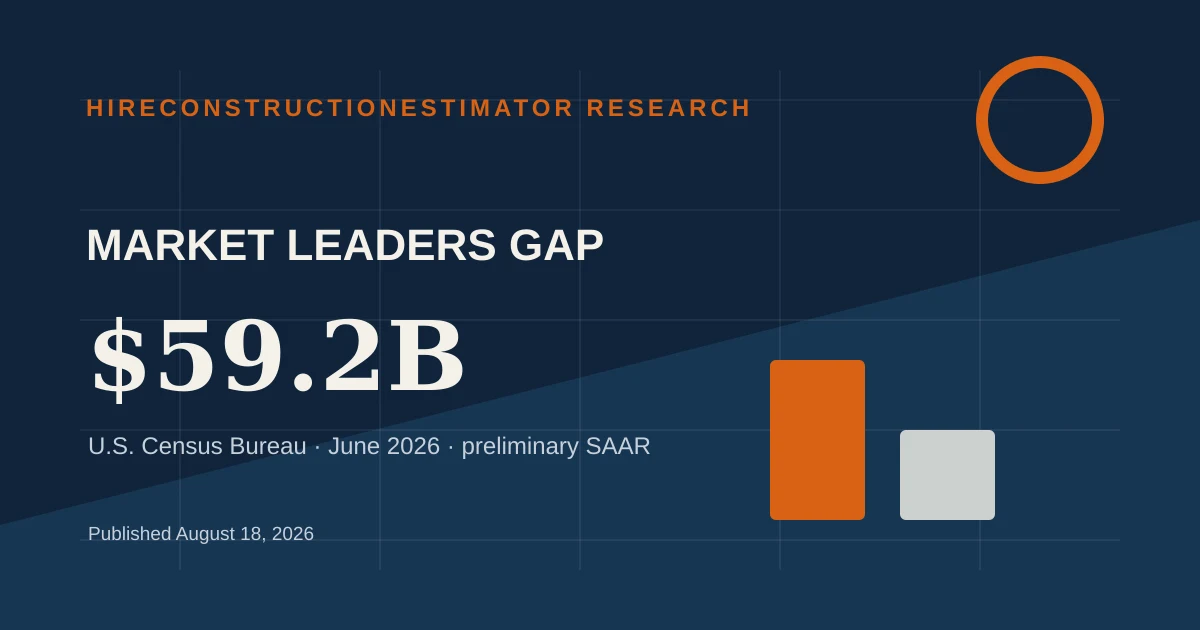
Power and highway activity exceeded educational and office activity by $59.2 billion at annualized rates in June 2026.
Contents
Key takeaways
- Power and highway and street totaled $329.7 billion; educational and office totaled $270.5 billion.
- The infrastructure pair was about 21.9 percent larger than the building pair when the building pair is the comparison base.
- Leading category value does not rank project profitability, fit, complexity, or the amount of bid work available to one firm.
Choose comparable leaders
Educational and office were the two largest categories in the selected building set, summing to $270.5 billion. Power and highway and street were the two largest selected infrastructure values, summing to $329.7 billion.
Subtracting the building pair from the infrastructure pair yields $59.2 billion. All four inputs share the same June period and annual-rate unit, which makes the arithmetic consistent.
The ranking has a narrow meaning
Largest here means largest displayed national activity value among the named categories. It does not mean best margin, strongest local growth, most projects, or highest probability of award.
A pursuit review should still apply geographic fit, owner access, delivery method, bonding, schedule, and specialist availability. Those filters can reverse the order that matters to a particular contractor.
Budget review effort independently
Educational and office estimates can concentrate architectural, MEP, phasing, and tenant or program decisions. Power and highway estimates can concentrate equipment, earthwork, structures, traffic, testing, and public-procurement requirements.
Track bid value and planned reviewer hours as separate measures. The $59.2 billion gap frames national scale but cannot set a staffing ratio between the two estimating lanes.
Key data table
Use this table as a review aid. The headline statistic is sourced directly; the interpretation rows explain how to apply it without treating a market benchmark as a project quote.
| Data point | What it says | Estimator control |
|---|---|---|
| Primary statistic | Power and highway activity exceeded educational and office activity by $59.2 billion at annualized rates in June 2026. | Source 1. Validate the project basis. |
| Interpretation 1 | Power and highway and street totaled $329.7 billion; educational and office totaled $270.5 billion. | Source 1. Validate the project basis. |
| Interpretation 2 | The infrastructure pair was about 21.9 percent larger than the building pair when the building pair is the comparison base. | Source 1. Validate the project basis. |
What the data can and cannot do
Public labor, spending, productivity, and price series provide a common baseline. They can reveal direction, scale, and unusual movement. They cannot identify the exact labor crew, subcontractor coverage, waste factor, access constraint, or escalation risk on a specific project.
A responsible estimate keeps the public benchmark separate from local bid history. Record the source date, geography, units, seasonal treatment, and any conversion before using the number in an estimate review.
How estimators should use it
- Review whether senior estimating coverage spans the actual building and infrastructure pursuits rather than following national rank mechanically.
- Keep project count and estimating hours beside value because one large civil pursuit can dominate dollars without dominating every workflow touch.
Add a source note beside every adjusted rate. If the benchmark and recent quotes disagree, do not average them automatically. Investigate geography, scope, timing, units, and market segment first.
Data sources and methodology
The primary statistic is transcribed from the source identified in the source notes below. The additional links are a consistent reader reference set for broader labor, construction volume, productivity, and regional context. They do not support or alter the headline figure and are not presented as article-specific evidence.
- The U.S. Census Bureau published the June 2026 Construction Spending release on August 3, 2026. June values are preliminary.
- Calculations use the displayed Table 1 values in seasonally adjusted annual-rate units. Component sums and percentages may vary slightly because the published values are rounded.
- Every grouping is defined in the article. Editorial groups are not official Census series and do not represent project counts, prices, backlog, or forecasts.
Conservative convention: retain the published unit and date, avoid false precision, and treat national or sector data as a planning signal until local project evidence confirms it.
Frequently asked questions
Can this statistic set a project unit rate?
No. It can challenge or frame an assumption, but a project rate still needs current scope, geography, crew, productivity, supplier, and subcontractor evidence.
How often should the source be checked?
Check the primary release before a major estimate update and record the release or access date in the estimate notes.
Why are reader context sources included?
They give readers a consistent path to broader official construction and labor series. They are not evidence for the headline statistic and do not replace or alter its primary source.
Conclusion
Power and highway activity exceeded educational and office activity by $59.2 billion at annualized rates in June 2026. Use the figure as a documented benchmark, preserve the source date and units, and require project-specific evidence before changing a bid assumption. Review our construction estimating process for the control sequence. If you need production capacity around that review process, see our construction estimator VA service.