
Cross Market Comparisons
Top-Three Building Market Concentration in June 2026
A focused analysis of concentration among the three largest categories in a defined seven-market building set.
By HireConstructionEstimator Editorial Team | Published August 18, 2026
1 primary + 14 reader context sources | Verified August 18, 2026
Top-Three Building Market Concentration in June 2026
Key stats
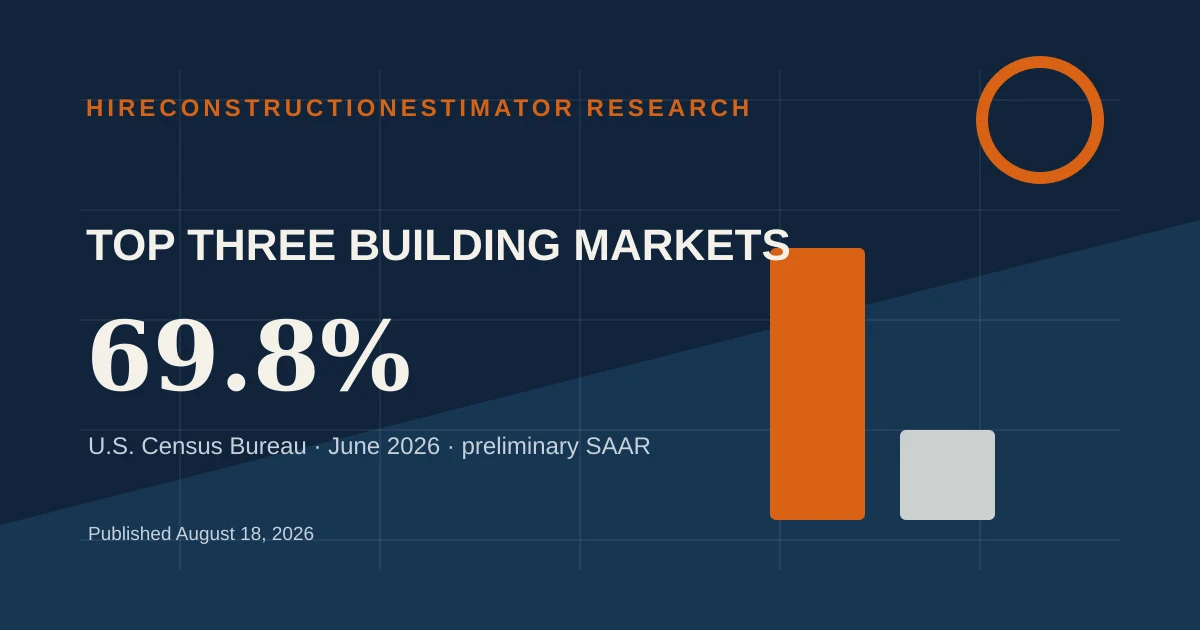
Educational, office, and commercial construction totaled $391.7 billion, about 69.8 percent of the $561.3 billion selected building-market total in June 2026.
Contents
Key takeaways
- The three categories were the largest displayed values among the seven named building markets in this analysis.
- Health care, amusement and recreation, lodging, and public safety together supplied the other $169.6 billion.
- A national value concentration does not measure local project availability, estimating complexity, or likely award volume.
Define the seven-market set
The selected building denominator includes educational, office, commercial, health care, amusement and recreation, lodging, and public safety construction. The first three values add to $391.7 billion; all seven add to $561.3 billion.
These are activity values at seasonally adjusted annual rates. They are not floor area, project counts, or contract awards, and the selected set is not an official Census aggregate.
Concentration changes the review question
A 69.8 percent share makes the three large categories useful places to test specialist coverage. Education may bring occupied-campus phasing, office work may divide shell and tenant scope, and commercial work may turn on opening dates and rollout standards.
Those differences matter more to estimating assignments than the combined percentage alone. Review actual document maturity, bid dates, system density, and quote gaps before moving staff.
Do not discard the smaller markets
The remaining $169.6 billion is still a substantial annualized value, but it is spread across four markets with distinct programs and procurement conditions. A compact public-safety job can require controls that a much larger private project does not.
Use concentration as a portfolio prompt rather than a pursuit rule. Qualification, owner relationships, geography, delivery method, and available review time remain the decision evidence.
Key data table
Use this table as a review aid. The headline statistic is sourced directly; the interpretation rows explain how to apply it without treating a market benchmark as a project quote.
| Data point | What it says | Estimator control |
|---|---|---|
| Primary statistic | Educational, office, and commercial construction totaled $391.7 billion, about 69.8 percent of the $561.3 billion selected building-market total in June 2026. | Source 1. Validate the project basis. |
| Interpretation 1 | The three categories were the largest displayed values among the seven named building markets in this analysis. | Source 1. Validate the project basis. |
| Interpretation 2 | Health care, amusement and recreation, lodging, and public safety together supplied the other $169.6 billion. | Source 1. Validate the project basis. |
What the data can and cannot do
Public labor, spending, productivity, and price series provide a common baseline. They can reveal direction, scale, and unusual movement. They cannot identify the exact labor crew, subcontractor coverage, waste factor, access constraint, or escalation risk on a specific project.
A responsible estimate keeps the public benchmark separate from local bid history. Record the source date, geography, units, seasonal treatment, and any conversion before using the number in an estimate review.
How estimators should use it
- Test whether reviewer skills and subcontractor outreach cover the actual office, education, and commercial opportunities on the bid calendar.
- Track the four smaller categories independently so a concentration headline does not hide deadline or specialty-scope pressure.
Add a source note beside every adjusted rate. If the benchmark and recent quotes disagree, do not average them automatically. Investigate geography, scope, timing, units, and market segment first.
Data sources and methodology
The primary statistic is transcribed from the source identified in the source notes below. The additional links are a consistent reader reference set for broader labor, construction volume, productivity, and regional context. They do not support or alter the headline figure and are not presented as article-specific evidence.
- The U.S. Census Bureau published the June 2026 Construction Spending release on August 3, 2026. June values are preliminary.
- Calculations use the displayed Table 1 values in seasonally adjusted annual-rate units. Component sums and percentages may vary slightly because the published values are rounded.
- Every grouping is defined in the article. Editorial groups are not official Census series and do not represent project counts, prices, backlog, or forecasts.
Conservative convention: retain the published unit and date, avoid false precision, and treat national or sector data as a planning signal until local project evidence confirms it.
Frequently asked questions
Can this statistic set a project unit rate?
No. It can challenge or frame an assumption, but a project rate still needs current scope, geography, crew, productivity, supplier, and subcontractor evidence.
How often should the source be checked?
Check the primary release before a major estimate update and record the release or access date in the estimate notes.
Why are reader context sources included?
They give readers a consistent path to broader official construction and labor series. They are not evidence for the headline statistic and do not replace or alter its primary source.
Conclusion
Educational, office, and commercial construction totaled $391.7 billion, about 69.8 percent of the $561.3 billion selected building-market total in June 2026. Use the figure as a documented benchmark, preserve the source date and units, and require project-specific evidence before changing a bid assumption. Review our construction estimating process for the control sequence. If you need production capacity around that review process, see our construction estimator VA service.